|
Supreme Court Upholds 28% GST on Face Value of Online Gaming Bets
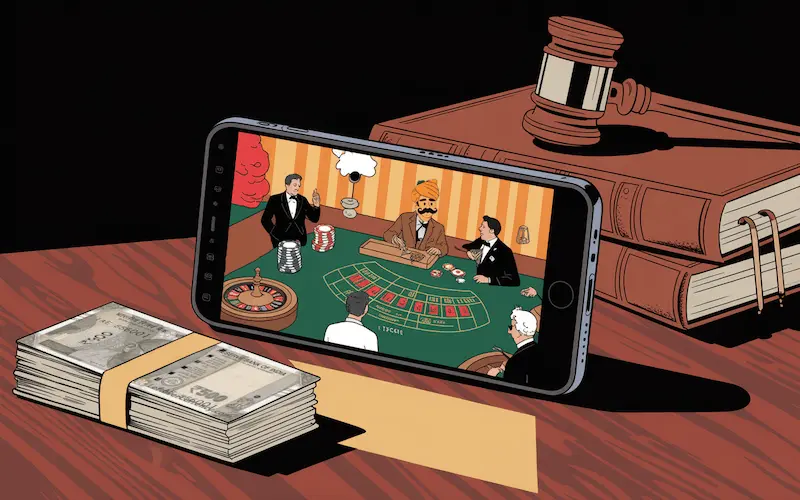
The Supreme Court has upheld the levy of 28% GST on the full face value of online gaming bets and validates state laws banning online betting and gambling. The ruling is relevant now because the gaming industry faces a potential tax liability of around ₹2.5 lakh crore.
Online Gaming Regulation and Supreme Court Ruling:
| Dimension | Key Details |
|---|---|
| Online Gaming | Online gaming refers to the playing of digital games over the internet, often involving real money stakes. |
| Organised Online Gaming | Organised online gaming comprises fantasy sports, real money games, casino-style games, skill-based games, esports, and casual gaming. |
| Fantasy Sports | Fantasy sports include platforms where users create virtual teams based on real players. |
| Real Money Games | Real money games include card games like Rummy and Poker played for monetary stakes. |
| Casino-Style Games | Casino-style games include online versions of traditional casino games. |
| Skill-Based Games | Skill-based games require strategic decision-making and are often played for cash prizes. |
| Esports and Casual Gaming | Esports and casual gaming include competitive video gaming with prize pools. |
| Games of Skill | Games of skill are games where outcomes depend predominantly on the player’s mental ability, knowledge, and judgement. |
| Games of Chance | Games of chance are games where outcomes depend largely on luck or random factors. |
| State List Entry 34 | Entry 34 of the State List gives states the power to legislate on betting and gambling. |
| State List Entry 62 | Entry 62 of the State List authorises states to impose taxes on betting and gambling. |
| Promotion and Regulation of Online Gaming Act, 2025 | The Promotion and Regulation of Online Gaming Act, 2025, is a central law passed to ban online money games and is pending notification after Presidential assent. |
| State-Specific Laws | Tamil Nadu, Karnataka, Andhra Pradesh, and Telangana have passed laws banning online gaming with monetary stakes. |
| Information Technology Rules, 2023 | The Information Technology Rules, 2023, regulate online gaming intermediaries and require self-regulatory bodies to certify permissible online games. |
| GST Framework | The GST Council has imposed 28% GST on the full face value of online gaming bets, lotteries, casinos, and horse racing in October 2023. |
| Industry Argument on GST | The gaming industry argues that GST should be levied on Gross Gaming Revenue, the platform’s commission, rather than the entire face value of bets. |
| Tax Liability | Show-cause notices allege GST evasion of approximately ₹1.12 lakh crore, with potential penalties of up to 100%, bringing total liability to around ₹2.5 lakh crore. |
| Tamil Nadu Law | Tamil Nadu brought in an ordinance in November 2020, later replaced by the Tamil Nadu Gaming and Police Laws (Amendment) Act, 2021, to prohibit and criminalise online games played for money or stakes. |
| Karnataka Law | Karnataka passed the Karnataka Police (Amendment) Act, 2021, banning all forms of wagering or betting except lottery and horse racing. |
| High Court Rulings | The Madras High Court and Karnataka High Court struck down laws or relevant provisions banning online gaming, while distinguishing between games of skill and games of chance. |
| Supreme Court on GST | The Supreme Court confirms the constitutional validity of bringing organised online gaming activities with money stakes under the GST regime. |
| GST Valuation | The Supreme Court upholds valuation rules under CGST for determining taxable supplies for lotteries, betting, gambling, horse racing, and casinos. |
| Face Value of Bets | The Supreme Court rejects the argument that GST should be levied on Gross Gaming Revenue rather than the face value of bets. |
| Online Gaming under GST | Online gaming activities, including fantasy sports and other games played on digital platforms involving staking upon uncertain outcomes, constitute betting and gambling for the GST framework. |
| State-Level Bans | The Supreme Court upholds Tamil Nadu and Karnataka laws prohibiting online games played for money or stakes. |
| Skill versus Chance | The Supreme Court holds that when the element of betting and gambling enters the picture, the nature of the game ceases to be relevant. |
| Betting on Skill Games | Betting on games of skill does not enjoy immunity merely because skill is involved. |
| Fundamental Right | Companies cannot claim violation of the fundamental right to practise any trade or business under Article 19(1)(g) for activities harmful to public welfare. |
| Public Health and Social Concerns | The Supreme Court observes that addiction to online betting creates disturbance in society, damages social tranquillity and individual well-being, and states have a duty to maintain public health and protect citizens. |
| Centre’s 2025 Law | The ruling has implications for the validity of the Promotion and Regulation of Online Gaming Act, 2025, which is also under Supreme Court consideration. |
| Centre’s Argument | The Centre argues that unregulated online gaming has links with terror financing and money laundering, protects youth and vulnerable populations, and safeguards financial systems and national security. |