|
Study Maps Black Hole Jets Heating CGM
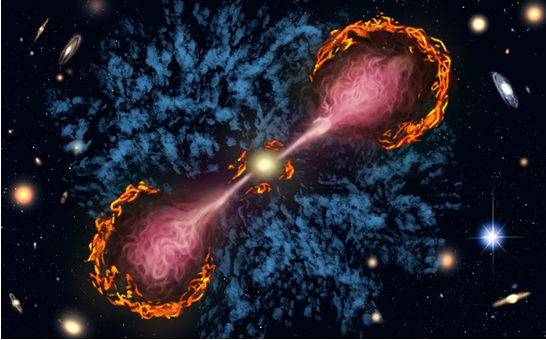
A recent study shows that relativistic jets launched by central supermassive black holes energetically “punch” into the surrounding Circumgalactic Medium (CGM), heating the gas and suppressing star formation. The research is done by Raman Research Institute (RRI), Bengaluru, and Arizona State University (ASU), and it reports observational evidence on how jet energy transfer heats the CGM.
Study on Black Hole Jets and the Circumgalactic Medium:
| Dimension | Key Details |
|---|---|
| CGM definition | The Circumgalactic Medium (CGM) comprises a vast, diffuse halo of gas and dust extending 10 to 20 times beyond the visible stellar disk of a galaxy. |
| Role of CGM in galaxies | The CGM serves as the primary gas reservoir that feeds galaxies. |
| Star formation under normal CGM conditions | Under normal conditions, cool gas in the CGM gradually loses thermal energy, collapses, and clumps together under gravity to trigger star formation. |
| Research institutions | The research is done by Raman Research Institute (RRI), Bengaluru, and Arizona State University (ASU). |
| Directional energy transfer by jets | Relativistic jets of hot plasma (charged particles) transfer energy along a focused vector rather than heating the CGM uniformly in all directions. |
| Jet-CGM collision mechanism | When a high-velocity jet collides with the CGM, it generates a localized shockwave or jerk that energizes and ionizes the ambient gas. |
| Dual “braking” peak excitation zones | The excitation signal of the energised gas peaks in two spatial zones: inner edge at the boundary of the stellar disk where the jet first hits dense interior CGM gas; and outer boundary at the outer fringe of the CGM where the decelerated jet delivers a final “fist-bump” into the intergalactic medium. |
| Mechanism suppressing star formation | The thermal energy deposited by the jet prevents CGM gas from cooling down, and lacking cool gas, the host galaxy cannot synthesize new stars. |
| Galaxy evolution outcome described | The host galaxy gradually evolves from an active, star-forming galaxy into a “quiet” or passive elliptical galaxy under an AGN feedback mechanism. |
| Scale comparison | A central Supermassive Black Hole (SMBH), spatially no larger than the Solar System, can shape the evolutionary fate of a host galaxy spanning hundreds of thousands of light-years. |
| Observational cosmology relevance | The study provides observational evidence explaining why massive galaxies in the universe do not grow indefinitely into ultra-luminous star monsters. |