|
Lancet Commission Calls for Decentralised Integrated Delivery Systems Linking Primary to Secondary Care
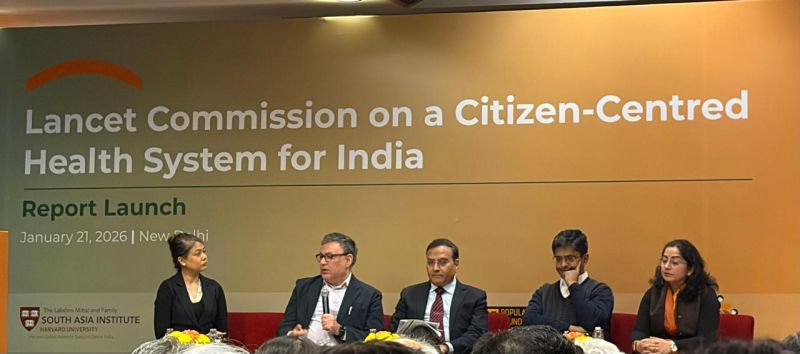
The Lancet Commission report presents a roadmap for India to achieve Universal Health Coverage (UHC) by 2047. It flags systemic challenges in health service delivery and financing, and provides reform suggestions including decentralised integrated delivery systems linking primary care networks to secondary hospitals.
Lancet Commission Report on Universal Health Coverage (UHC) for India
| Dimension | Key Details |
|---|---|
| Report focus | Provides for a roadmap for India to achieve Universal Health Coverage (UHC) by 2047 |
| Fragmented delivery | Siloed vertical disease-specific programmes and lacks coordination between primary, secondary, and tertiary care |
| Financial hardship | Out-of-pocket health spending remains a major cause of financial strain despite Ayushman Bharat, mainly due to outpatient care and medicine costs. |
| Quality variations | Comprises a “know-do” gap where providers fail to adhere to clinical protocols, leading to low-value care and poor health outcomes |
| Epidemiological transition | Rising burden of non-communicable diseases (NCDs) alongside infectious diseases |
| Empower citizens | Strengthens local governance, improves grievance redressal, increases access to health data, and supports Village Health, Sanitation, and Nutrition Committees. |
| Public sector reform (IDS) | Decentralized Integrated Delivery Systems (IDS) where modernized primary care networks are linked to secondary hospitals, with each IDS serving a defined population |
| Align private sector with UHC goals | Moves to capitation and global budgets to promote value-based preventive care, with voluntary insurance covering outpatient care and medicines. |
| Technology scale-up | Scaling up technology including Ayushman Bharat Digital Mission |
| Transparent governance | Real-time data for surveillance |
| Evidence-based refinement | Connecting researchers, policymakers, and providers for evidence-based refinement |