|
Delhi Police Protest Detentions in New Delhi
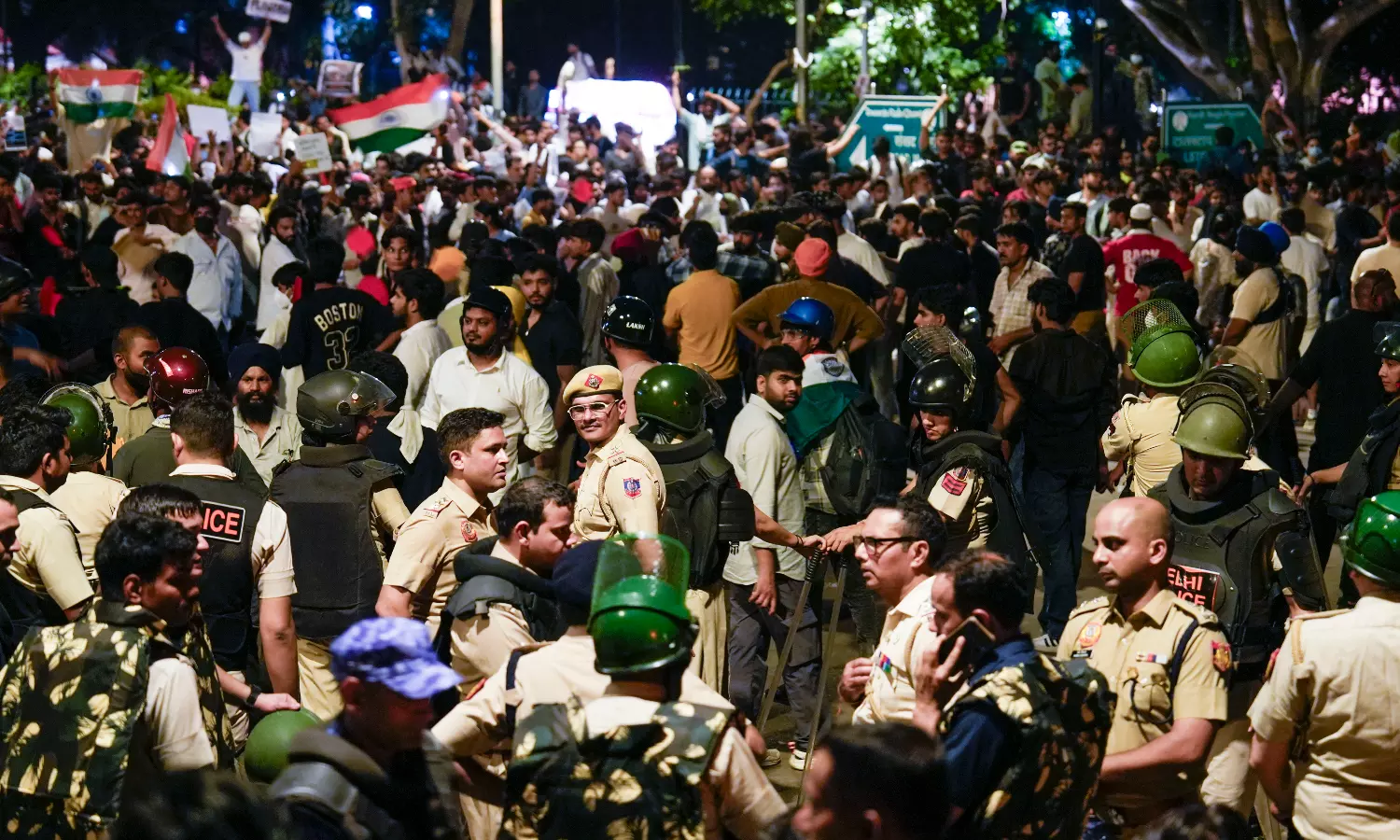
Delhi Police detain Opposition leaders, including Rahul Gandhi, during protests in New Delhi over alleged irregularities in the ECI’s Special Intensive Revision (SIR) exercise and demands for the resignation of Chief Election Commissioner Gyanesh Kumar. Since October 2, Delhi Police have detained hundreds of protesters, bringing focus on how “detention” differs from “arrest” under the Bharatiya Nagarik Suraksha Sanhita (BNSS) and related provisions.
BNSS Provisions on Detention and Arrest:
| Dimension | Key Details |
|---|---|
| Arrest | Arrest is a formal act of police taking a person into custody in connection with an offence, marking the beginning of criminal proceedings. |
| Detention | Detention is not defined by the Bharatiya Nagarik Suraksha Sanhita (BNSS), and the BNSS grants police powers to stop, remove, or temporarily hold people in certain situations. |
| BNSS status | The BNSS replaces the CrPC. |
| Section 170, BNSS | Section 170 provides for preventive action before an offence: a police officer who knows of a design to commit any cognizable offence may arrest without a magistrate’s order or warrant if the offence cannot be otherwise prevented. |
| Section 172, BNSS | Section 172 authorises a police officer to detain or remove any person resisting, refusing, ignoring, or disregarding a lawful direction, and mandates producing the person before a magistrate or, in petty cases, releasing them within 24 hours. |
| What is new in BNSS (vs CrPC) | Section 172 expressly allows police to detain or remove someone who refuses a lawful direction, and Section 172(2) is stated as new, with the CrPC having no equivalent. |
| Section 163, BNSS | Delhi Police have imposed Section 163, BNSS across New Delhi on October 2. |
| Section 223, BNS | Section 223 of the Bharatiya Nyaya Sanhita (BNS) provides that disobeying a prohibitory order is an offence. |
| Detention escalating to arrest | Where disobedience of a prohibitory order is treated as an offence under Section 223, BNS, detention can escalate into arrest with an FIR. |
| Distinct from preventive detention | The police power discussed is distinct from preventive detention, which allows holding a person without trial under special laws like the National Security Act. |
| Judicial standard | Courts require that police action restricting liberty cannot be arbitrary, and officers must justify why restricting liberty is necessary. |
| Article 22 safeguards | Article 22 mandates production before a magistrate within 24 hours, information about grounds of arrest, and the right to legal representation. |
| Supreme Court position | The Supreme Court has repeatedly held that written grounds of arrest must be furnished, and has ruled last month that violating Article 22 safeguards makes an arrest unconstitutional. |
| Section 38, BNSS | Section 38 allows an arrested person to meet an advocate of their choice during interrogation, though not throughout. |
| Free legal aid | Free legal aid is provided at State cost if a person cannot afford a lawyer. |
| Section 43(5), BNSS | Section 43(5) bars arresting a woman between sunset and sunrise, except in exceptional circumstances with a judicial magistrate’s prior permission. |
| DK Basu v. State of West Bengal (1997) safeguards | DK Basu v. State of West Bengal (1997) lays down safeguards for arrest or detention: officers wear visible name tags; an arrest memo is attested by at least one witness; injuries are recorded; and family members are informed. |
| Consequences of non-compliance | Non-compliance with DK Basu safeguards provides for departmental action or contempt proceedings against officers. |
| Status of short-term detention safeguards | The safeguards applicable to such short-term detentions remain largely untested, and no case on this has reached the Supreme Court. |