|
Astronomers Observe White Dwarf Creating Colourful Shockwave While Moving Through Space
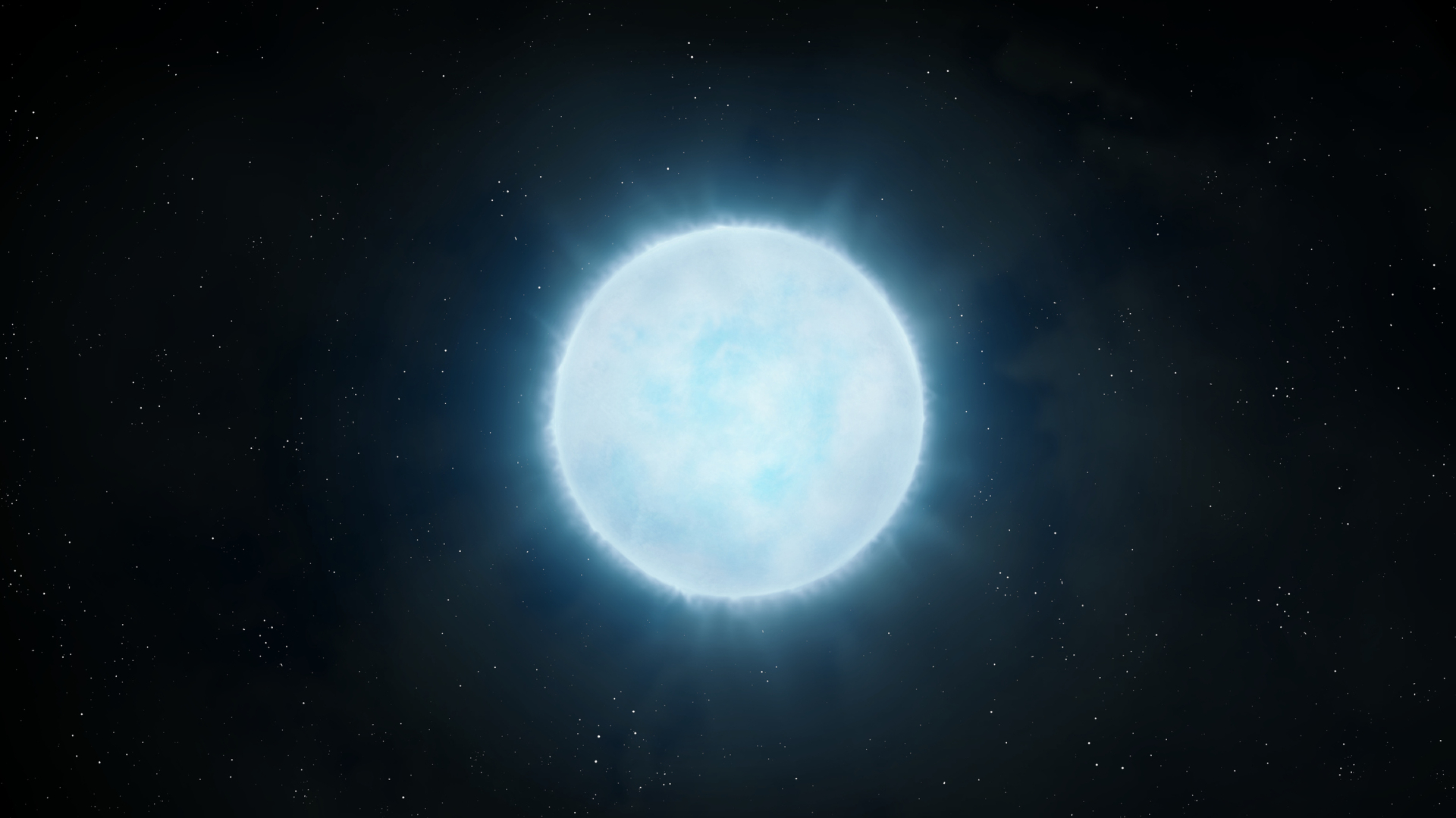
Astronomers observe a white dwarf creating a colorful shockwave while moving through space. The report details what a white dwarf is and lists its key characteristics relevant to stellar evolution and astronomical measurement.
White Dwarf:
| Dimension | Key Details |
|---|---|
| Definition | Provides for being the stellar core left behind after a dying star exhausts its nuclear fuel and expels its outer layers to form a planetary nebula. |
| Stellar fate | Applies to stars like the Sun becoming white dwarfs after exhausting their nuclear fuel. |
| Nuclear fusion status | Stellar core that no longer supports nuclear fusion reactions that generate energy, but remains extremely hot. |
| Typical size and mass | Half as massive as the Sun, yet only slightly bigger than Earth. |
| Density comparison | One of the densest collections of matter, surpassed only by neutron stars. |
| Composition | Helium, carbon, and oxygen nuclei in a sea of highly energetic electrons. |
| Support mechanism | Supported against their own gravitation by the degeneracy pressure of the electron gas in their interior (not by normal gas pressure). |
| Degeneracy pressure | Increased resistance exerted by electrons composing the gas, as a result of stellar contraction. |
| Cooling | Unless accreting matter from a nearby star, a white dwarf cools down over the next billion years or so. |
| End state | White dwarfs would ultimately form ‘black dwarfs’; the Universe is likely not old enough for any black dwarfs to exist yet. |
| Astronomical use | Luminosity of white dwarfs being used by astronomers to measure how long-ago star formation began in a particular region. |