|
ALMA Releases Largest-Ever High-Resolution Image of Milky Way’s Central Molecular Zone
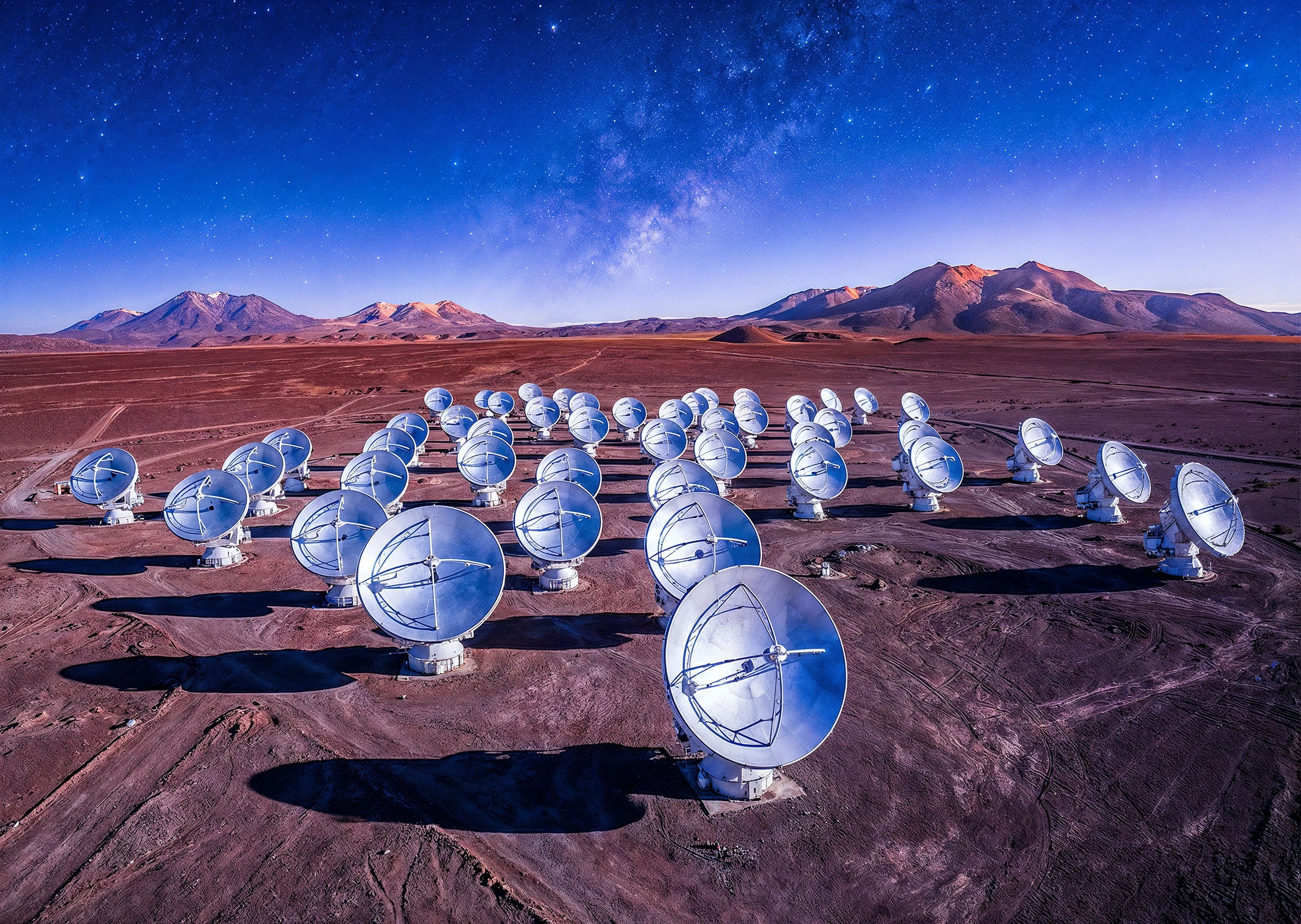
Astronomers released the largest image of the Milky Way’s central region using the ALMA telescope under the ACES survey. The image maps the Central Molecular Zone in unprecedented detail.
Atacama Large Millimeter/submillimeter Array (ALMA):
| Dimension | Key Details |
|---|---|
| Location | Located in the Atacama Desert in Chile on the Chajnantor Plateau. |
| Altitude | Situated at an altitude of about 5,000 metres. |
| Site Characteristics | High altitude and extremely dry conditions provide suitable environment for radio astronomy. |
| Operational Year | Operational since 2013. |
| International Collaboration | Joint venture led by European Southern Observatory, the United States National Science Foundation and the National Institutes of Natural Sciences of Japan in cooperation with Chile. |
| Telescope Structure | Interferometer consisting of 66 high precision antennas functioning together as a single instrument. |
| Antenna Composition | Comprises 54 antennas of 12 metre diameter and 12 antennas of 7 metre diameter. |
| Observed Wavelengths | Operates in millimetre and submillimetre wavelengths ranging from 0.32 millimetres to 3.6 millimetres. |
| Maximum Baseline | Antennas can be positioned up to 16 kilometres apart. |
| Resolution | Provides imaging resolution up to ten times sharper than the Hubble Space Telescope. |
| Core Computing System | Uses the ALMA Correlator supercomputer to combine signals from antennas. |
| Observation Technique | Uses interferometry which combines signals from multiple antennas to mimic a telescope with diameter equal to the distance between the furthest antennas. |
| Scientific Applications | Provides observations for star and planet formation molecular clouds protoplanetary disks early galaxies and chemical composition of space. |
| Central Molecular Zone Mapping | ACES survey mapped the Central Molecular Zone of the Milky Way across an area exceeding 650 light years. |
| Gas Structure Discovery | Detected long filamentary streams of cold molecular gas feeding star forming regions. |
| Detected Molecules | Molecules detected include silicon monoxide methanol ethanol and acetone. |
| Star Formation Observation | The Central Molecular Zone shows lower star formation rates despite high gas density. |