- 1UPSC CSE I - 2026Consider the following statements relating to the use of the place-value system in India:
- The earliest epigraphic use of the place-value system in India is found in the Mankani plates from Gujarat (AD 595 – 596).
- In the ninth century, place-values become general in inscriptions all over India.
- The place-values have been found in Sanskrit inscriptions in South-east Asia as early as the seventh century.
Which of the statements given above are correct? - 2UPSC CSE I - 2025Fa-hien (Faxian), the Chinese pilgrim, travelled to India during the reign of
- 3UPSC CSE I - 2022With reference to Indian history, consider the following pairs:
Historical person Known as 1. Aryadeva Jaina scholar 2. Dignaga Buddhist scholar 3. Nathamuni Vaishnava scholar How many pairs given above are correctly matched? - 4UPSC CSE I - 2021With reference to the history of ancient India, Bhavabhuti, Hastimalla and Kshemeshvara were famous
- 5UPSC CSE I - 2021With reference to the history of ancient India, which of the following statements is/are correct?
- Mitakshara was the civil law for upper castes and Dayabhaga was the civil law for lower castes.
- In the Mitakshara system, the sons can claim right to the property during the lifetime of the father, whereas in the Dayabhaga system, it is only after the death of the father that the sons can claim right to the property.
- The Mitakshara system deals with the matters related to the property held by male members only of a family, whereas the Dayabhaga system deals with the matters related to the property held by both male and female members of a family.
- 6UPSC CSE I - 2020
With reference to the period of Gupta dynasty in ancient India, the towns Ghantasala, Kadura and Chaul were known as:
- 7UPSC CSE I - 2020
With reference to the history of India, the terms ‘kulyavapa’ and ‘dronavapa’ denote:
- 8UPSC CSE I - 2019With reference to forced labour (Vishti) in India during the Gupta period, which one of the following statements is correct?
- 9UPSC CSE I - 2012With reference to the guilds (Shreni) of ancient India that played a very important role in the country's economy, which of the following statements is/are correct?
- Every guild was registered with the central authority of the State and the king was the chief administrative authority on them.
- The wages, rules of work, standards and prices were fixed by the guild.
- The guild had judicial powers over its own members.
Select the correct answer using the codes given below: - 10UPSC CSE I - 2012With reference to the scientific progress of ancient India, which of the statements given below are correct?
- Different kinds of specialized surgical instruments were in common use by 1st century AD.
- Transplant of internal organs in the human body had begun by the beginning of 3rd century AD.
- The concept of sine of an angle was known in 5th century AD.
- The concept of cyclic quadrilaterals was known in 7th century AD.
- 11UPSC CSE I - 2010
Why did Buddhism start declining in India in the early medieval times?
- Buddha was by that time considered as one of the incarnations of Vishnu and thus became a part of Vaishnavism.
- Invading tribes, from Central Asia till the time of last Gupta king adopted Hinduism and persecuted Buddhists.
- Kings of Gupta dynasty were strongly opposed to Buddhism.
Which of the statements given above is/are correct?
- 12UPSC CSE I - 2003
'Mrichchhakatika' an ancient Indian book written by Shudraka deals with:
- 13UPSC CSE I - 2002
The ancient Indian play Mudrarakshasa of Visakhadutt has its subject on:
- 14UPSC CSE I - 2000
Assertion (A): The origin of feudal system in ancient India can be traced to military campaigns. Reason (R): There was considerable expansion of the feudal system during the Gupta period.
- 15UPSC CSE I - 1999
Which one of the following ports handled the North Indian trade during the Gupta period?
- 16UPSC CSE I - 1998
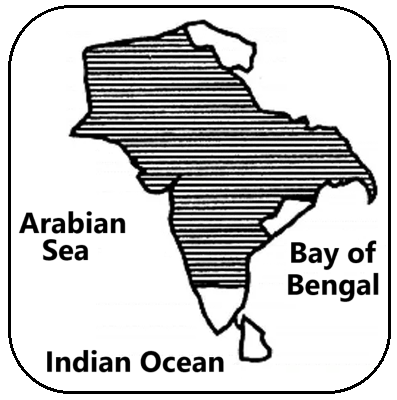
The given map relates to:
- 17UPSC CSE I - 1997
Match List-I with List-II and select the correct answer using the codes given below the lists:
List-I (Author) List-II (Text) A. Varahamihira 1. Prabandha Chintamani B. Vishakhadatta 2. Mrichchhakatika C. Sudraka 3. Brihat-Samhita P. Bilhana 4. Devi-Chandraguptam 5. Vikramankadeva-Charita - 18UPSC CSE I - 1997
The silver coins issued by the Guptas were called:
- 19UPSC CSE I - 1996
Who among the following is known for his work on medicine during the Gupta period?
- 20UPSC CSE I - 1996
Match List-I with List-II and select the correct answer:
List-I List-II A. Vishakhadatta 1. Medicine B. Varahamihira 2. Drama C. Charaka 3. Astronomy D. Brahmagupta 4. Mathematics