- 1UPSC CSE I - 2025Consider the following statements about turmeric during the year 2022-23 :
- India is the largest producer and exporter of turmeric in the world.
- More than 30 varieties of turmeric are grown in India.
- Maharashtra, Telangana, Karnataka and Tamil Nadu are major turmeric producing States in India.
Which of the statements given above are correct? - 2UPSC CSE I - 2024Which of the following countries are well known as the two largest cocoa producers in the world ?
- 3UPSC CSE I - 2023Consider the following statements :
- India has more arable area than China.
- The proportion of irrigated area is more in India as compared to China.
- The average productivity per hectare in Indian agriculture is higher than that in China.
How many of the above statements are correct? - 4UPSC CSE I - 2023Which one of the following best describes the concept of 'Small Farmer Large Field'?
- 5UPSC CSE I - 2022Consider the following States :
- Andhra Pradesh
- Kerala
- Himachal Pradesh
- Tripura
How many of the above are generally known as tea-producing States ? - 6UPSC CSE I - 2021How is permaculture farming different from conventional chemical farming?
- Permaculture farming discourages monocultural practices but in conventional chemical farming, monocultural practices are pre-dominant.
- Conventional chemical farming can cause increase in soil salinity but the occurrence of such phenomenon is not observed in permaculture farming.
- Conventional chemical farming is easily possible in semi-arid regions but permaculture farming is not so easily possible in such regions.
- Practice of mulching is very important in permaculture farming but not necessarily so in conventional chemical farming.
Select the correct answer using the code given below. - 7UPSC CSE I - 2019Which one of the following groups of plants was domesticated in the 'New World' and introduced into the 'Old World'?
- 8UPSC CSE I - 2017Which of the following practices can help in water conservation in agriculture ?
- Reduced or zero tillage of the land
- Applying gypsum before irrigating the field
- Allowing crop residue to remain in the field
Select the correct answer using the code given below : - 9UPSC CSE I - 2015Consider the following statements :
- The Accelerated Irrigation Benefits Programme was launched during 1996-97 to provide loan assistance to poor farmers.
- The Command Area Development Programme was launched in 1974-75 for the development of water-use efficiency.
Which of the statements given above is/are correct? - 10UPSC CSE I - 2014In the context of food and nutritional security of India, enhancing the 'Seed Replacement Rates' of various crops helps in achieving the food production targets of the future. But what is/are the constraint/constraints in its wider/greater implementation?
- There is no National Seeds Policy in place.
- There is no participation of private sector seed companies in the supply of quality seeds of vegetables and planting materials of horticultural crops.
- There is a demand-supply gap regarding quality seeds in case of low value and high volume crops.
Select the correct answer using the code given below. - 11UPSC CSE I - 2010
Though coffee and tea both are cultivated on hill slopes, there is some difference between them regarding their cultivation. In this context, consider the following statements:
- Coffee plant requires a hot and humid climate of tropical areas whereas tea can be cultivated in both tropical and subtropical areas.
- Coffee is propagated by seeds but tea is propagated by stem cuttings only.
Which of the statements given above is/are correct?
- 12UPSC CSE I - 2010
The approximate representation of land use classification in India is:
- 13UPSC CSE I - 2010
Consider the following statements:
- Chikmagalur is well-known for sugar production.
- Mandya is well-known as a coffee-producing region.
Which of the statements given above is/are correct?
- 14UPSC CSE I - 2008
Norman Ernest Borlaug, who is regarded as the father of the Green Revolution in India, is from which country?
- 15UPSC CSE I - 2007
Assertion (A): There are no tea plantations in any African country.
Reason (R): Tea plants need fertile soil with high humus. - 16UPSC CSE I - 2005
Consider the following statements:
- India is the only country in the world producing all the five known commercial varieties of silk.
- India is the largest producer of sugar in the world.
Which of the statements given above is/are correct?
- 17UPSC CSE I - 2003
Consider the following statements:
- India is the original home of the cotton plant
- India is the first country in the world to develop hybrid cotton variety leading to increased production
Which of these statements is/are correct?
- 18UPSC CSE I - 2002
Consider the following high yielding varieties of crops in India:
- Arjun
- Jaya
- Padma
- Sonalika
Which of these are of wheat?
- 19UPSC CSE I - 2000
Assertion (A): In Australia, cattle rearing is done more for meat than for milk. Reason (R): Australians are traditionally nonvegetarians.
- 20UPSC CSE I - 2000
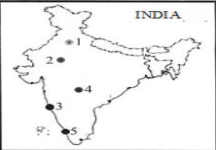
Match the cities labelled as 1, 2, 3, 4 and 5 in the given map with the names of the institutes located in these cities and select the correct answer using the codes given below the names of the institutes.
Names of Institute s A) Central Marine Fisheries Research Institute B) Central Sheep Breeding Farm C) National Dairy Research Institute D) National Institute of Agricultural Extension Management Codes:
- 21UPSC CSE I - 2000
The correct sequence in decreasing order of the four sugarcane producing States in India is
- 22UPSC CSE I - 1999
Match List I with List II and select the correct answer using the codes given below the lists:
List-I (Crop) List-II (Climatic
Conditions)A. Cotton 1. Rainfall 1000–1500 mm; Temperature
40°–60°CB. Flax 2. Rainfall 1500–2000 mm; Temperature
25°–35°CC. Sugar beet 3. Rainfall 600–800 mm; Temperature
5°–18°CD. Jute 4. Rainfall 500–1000 mm; Temperature
18°–22°C5. Rainfall 500–600 mm; Temperature
18°–22°CCodes:
- 23UPSC CSE I - 1998
The following are the major oilseeds produced in India:
- Sesamum
- Mustard
- Groundnut
- Soyabean
Which one of the following is the correct sequence of the descending order of the quantity of their production?
- 24UPSC CSE I - 1996
Which one of the following is an important crop of the Barak valley?
- 25UPSC CSE I - 1996
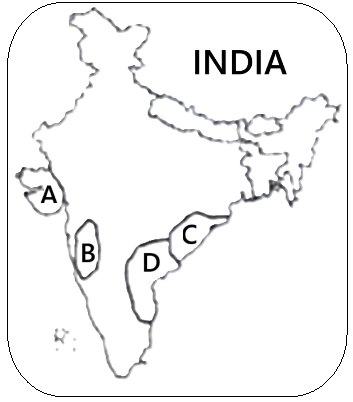
Consider the map given below:
The places marked A, B, C, and D in the map are respectively known for the cultivation of:
- 26UPSC CSE I - 1996
Which one of the following is cultivated by transplanting seedlings?
- 27UPSC CSE I - 1996
Which of the following pairs of states and their important crops are correctly matched?
- Kerala - Tapioca
- Maharashtra - Cotton
- West Bengal - Jute
- Gujarat - Groundnut